
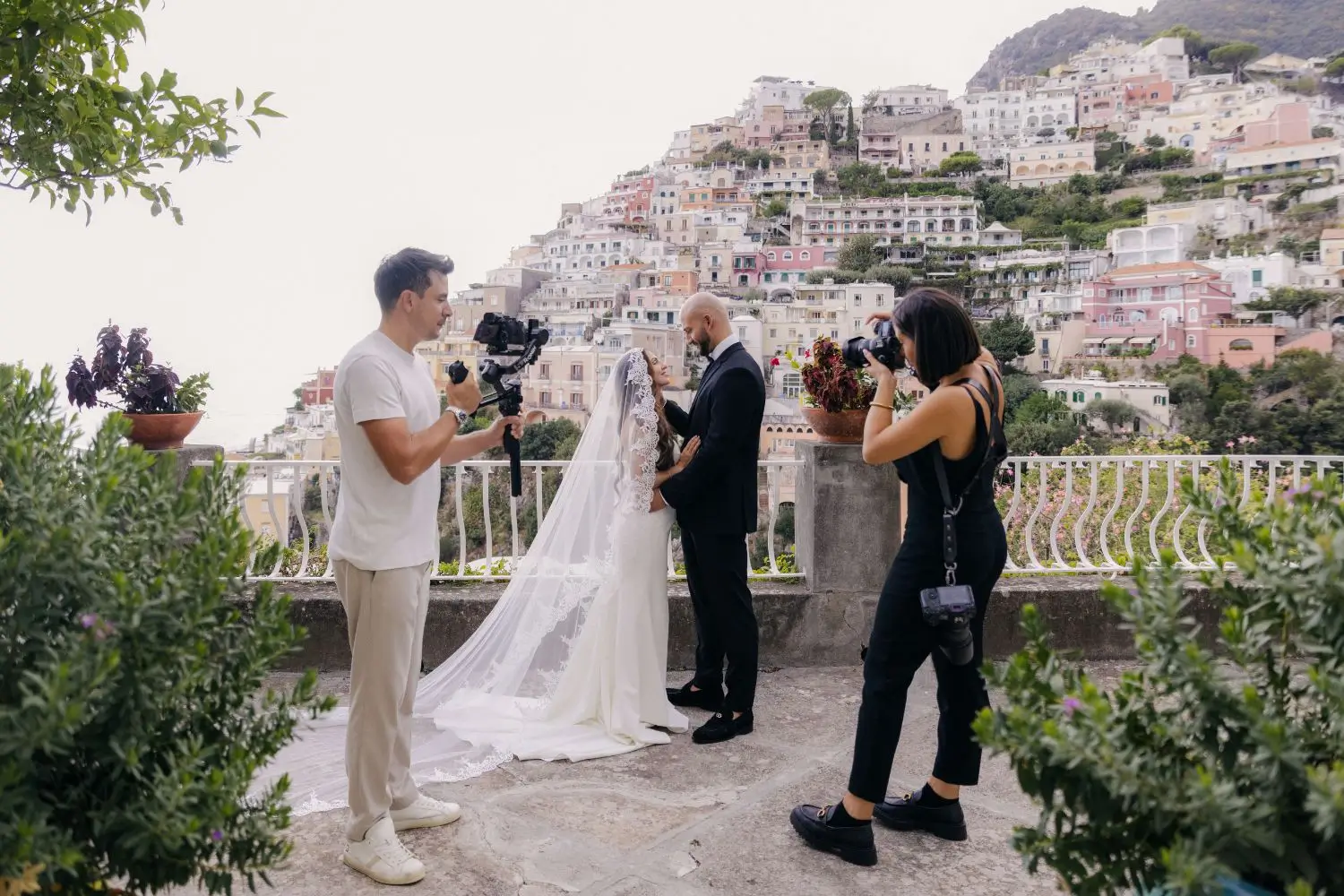
There’s a scene that plays out at every wedding: the photographer takes his place at the back of the aisle for the bride’s entrance, and the videographer does the same. Same angle, same lighting, same bated breath—each ready to capture the moment in their own way.
A second later, they silently go their separate ways: one steps forward to capture the expression of an emotional parent, while the other stays back to keep the bride and groom, the witnesses, and the entire aisle in the same frame.
They don’t get in each other’s way. They complement each other.
Two shades of the same moment: one still, one in motion. And when the photographer and videographer work in harmony, the result isn’t simply “beautiful photos and a beautiful video,” but a single visual memory, crafted by both, that captures this special day in its entirety.
The art of visual synergy: why photo and video are the “Power Duo” of weddings
A wedding photographer and videographer who work in harmony guarantee a cohesive, fluid visual result and a stress-free atmosphere on set. When these two professionals know each other, share the same timeline, and respect each other’s creative space, all the couple has to do is be present and let the story unfold.
Visual synergy at a wedding isn’t an optional extra for those seeking excellence—it’s the starting point. A photo album and a wedding film that seem to come from two different events (in terms of atmosphere, colors, and rhythm) reveal a lack of collaboration, regardless of the individual quality of each professional.
Shared goal, different languages: the difference between still photo and moving image
As you can easily imagine, photographers and videographers share the same set, but they operate according to profoundly different approaches.
The photographer seeks the moment: that fraction of a second when light, composition, and emotion converge into a single, perfect image. They often work with ambient light, requiring discretion and silence so as not to disrupt the natural flow of the moment.
The videographer, on the other hand, focuses on the sequence: the before and after, the movement, the sound, and the editing rhythm. They need freedom of movement, discreetly placed lavalier microphones, and shots that have a clear beginning and end. To better understand this distinction, it’s worth exploring the difference between a cinematographer and a videographer.
Two different languages, one goal: to capture the truth of a once-in-a-lifetime day.
The 5 real benefits of a harmonious collaboration between photographer and videographer
When a photographer and a videographer truly work in sync, the benefits extend beyond the technical quality of the final product. They encompass the entire experience of the day—both for the professionals on set and, above all, for the couple.
Here are the five concrete advantages of a harmonious collaboration—the ones that make the difference between a wedding that’s simply documented and one that’s truly told.
Aesthetic consistency and homogeneous narrative style
When the photographer and videographer meet before the wedding day, they share something fundamental: their vision. Together, they decide whether to go for a documentary or editorial aesthetic, a warm or cool color palette, and a discreet or more staged approach.
The result is a photo album and a wedding film that feel like part of the same story. Not two separate products, but a single visual narrative told through two complementary mediums. A harmony you can see and feel.
Intelligent spatial management during the ceremony and speeches
The ceremony is the most emotionally charged moment of the entire day, and it’s also the moment when space is most limited and movement is most restricted.
A well-coordinated team already knows—before the music begins—who will take which position during the entrance, where everyone will move during the exchange of rings, and who will step closer and who will remain at a distance during the kiss.
This planning isn’t rigidity—it’s freedom. Freedom to move without having to watch your back, to capture your own moment without fear of appearing in someone else’s shot. And, above all, freedom to truly be present for the couple.
The same applies to speeches at the reception—moments when the importance of professional audio in wedding videos becomes critical: here, the videographer needs silence around the lavalier microphones, and a photographer who’s aware of this will never approach with a flash at the wrong moments.
Timeline optimization: maximum output during the golden hour
The sunset couple session is the most precious (and also the shortest) moment of the entire day: the light lasts no more than twenty or thirty minutes, and every second is (literally) worth its weight in gold.
When the photographer and videographer work in sync, the session flows naturally: a movement captured simultaneously by both, a shared pause, a direction given just once. The couple doesn’t have to repeat the same walk three times for different shots, nor do they have to wait for one to finish before starting with the other.
The result is a video session during the golden hour that captures authentic moments, not rehearsed poses. And a couple who, at sunset, can finally enjoy the light instead of chasing after it.
Equipment sharing and backup solutions on set
On a wedding shoot, the unexpected isn’t an exception—it’s part of the game. A dead battery, a full memory card, a tripod that won’t hold up. In moments like these, a close-knit team becomes a mutual safety net.
The photographer who has worked with that videographer before knows where to find an extra lighting stand. The videographer knows they can count on a second set of eyes to manage the groups during family portraits. Small gestures that make a big difference, especially in moments when every minute lost is a moment of the wedding left untold.
A relaxed and stress-free experience for the couple
There’s something couples almost never mention but always sense: the tension between the vendors. When the photographer and videographer don’t know each other and move around the set with mutual distrust, that tension comes across to the couple in their body language, their hesitations, and the conflicting directions they receive just seconds apart.
A close-knit team, on the other hand, creates a calm and professional atmosphere that allows the bride and groom to forget about the cameras and truly enjoy their day. They don’t feel like they’re “on set.” They simply feel like they’re at their own wedding.
The challenges of two independent vendors and how to overcome them
Choosing a photographer and a videographer separately (from different portfolios, with different styles, and without them ever having met) is a valid choice. But it carries real risks that are worth understanding before signing the contracts.
The most common risk is competition for space: both want the best vantage point during key moments, and without a prior agreement, they may end up getting in each other’s way or, worse, appearing in each other’s shots.
The second risk is aesthetic dissonance: an album with warm tones and a film with a cool color palette, or a documentary-style approach in photos and a highly staged one in video, create a fragmented visual experience that does neither justice.
| Aspect | Coordinated team / In harmony | Independent vendors without synchrony |
| Framing | Agreed spaces, nobody in each other’s shot | Risk of finding the videographer in the photo or vice versa |
| Daily timeline | Single plan shared with the Wedding Planner | Possible delays and conflicting directions to the couple |
| Golden hour management | Single poses and movements captured simultaneously | Double posing times, stress for the couple |
| General atmosphere | Serene, discreet, and professional climate | Possible tension noticeable by the couple |
The good news is that these risks can almost always be anticipated by asking the right questions at the right time.
Practical guide for couples: how to guarantee perfect harmony between photo and video
You don’t need to hire a photographer and videographer from the same agency to have a well-coordinated team. You do, however, need to choose professionals with compatible styles who are willing to collaborate and are used to doing so. And be sure to ask the right questions before signing a contract.
The Secret Behind the Scenes at Wedding Key Studio
At our weddings, the first contact with the photographer takes place weeks before the event. We share the timeline, agree on positions during the ceremony, and work together to plan the sunset couple’s photo session. The First Look (the first glance between the bride and groom), in particular, is a moment we plan carefully: it’s brief, intimate, and once-in-a-lifetime, and it deserves that both of us know exactly where to be—without the couple noticing a thing.
Questions to ask the videographer and photographer before booking
Before finalizing your choice of vendors, it’s worth considering the essential questions to ask the videographer and posing a few key questions to both of them:
- “Have you worked together in the past or collaborated with professionals with a similar profile?”
- “How do you coordinate during key moments (First Look, ceremony, cake cutting)?”
- “What is your policy on sharing time during the couple session?”
- “How do you manage flashes and continuous lights so they don’t interfere with each other’s work?”
The answers to these questions reveal much more than portfolios ever do. A professional accustomed to working in a team responds naturally and precisely. Someone who has never considered this a priority hesitates.
For more tips on choosing the right videographer, it’s helpful to explore what sets a top-tier professional apart—not only technically, but also in terms of interpersonal skills.
The importance of the pre-wedding meeting with the Wedding Planner
And if there’s one best practice that really makes a difference, it’s this: a joint briefing between the wedding planner, photographer, and videographer, held at least two or three weeks before the wedding.
During that meeting, you’ll define the complete timeline for the day, the positions during the ceremony, the sequence of the couple’s photo session, the emotionally charged moments (First Look, entrance, kisses, speeches), and any specific technical requirements of the venue. This isn’t red tape—it’s the foundation upon which a seamless day is built.
For those planning a wedding in Italy, where vendors often come from different backgrounds and markets, this opportunity to align expectations is even more valuable. To explore all the logistical aspects in depth, the guide to planning a destination wedding in Italy is a comprehensive starting point.
Are you planning your wedding in Italy and want the assurance of a perfectly coordinated photo and video team? Contact Wedding Key Studio and find out how we’ll tell your story in perfect harmony.
Frequently asked questions about The Power Duo: Why Your Photographer and Videographer Must Work in Harmony
Is it necessary to hire a single team for wedding photography and videography?
It’s not mandatory to hire professionals from the same company, but it’s essential to choose people with compatible styles who are used to working together and willing to coordinate before the event. Synchronization on set doesn’t depend on which agency they come from—it depends on their willingness to work as a team.
What is the difference between how a wedding photographer and videographer work?
The photographer focuses on capturing static moments, composing light, and capturing specific emotions. The videographer documents movement, chronological sequence, sound, and dynamic audiovisual storytelling. These two different approaches work in harmony and complement each other.
What to do if the photographer and videographer have never met before?
All you need to do is put them in touch a few weeks before the wedding so they can share the timeline, agree on how to manage the spaces, and set priorities for key moments. A one-hour video call can prevent most problems on set.
How to prevent the photographer and videographer from appearing in each other’s shots?
Through advance planning of positions and the use of complementary focal lengths: one photographer works up close, the other uses a telephoto lens from a distance. Pre-event communication is everything.
Planning a Destination Wedding in Italy: The Ultimate Cinematic Guide
Plan your 2027 Italy destination wedding with our cinematic guide. Expert tips on top venues in Tuscany, Lake Como & Amalfi to ensure your luxury wedding film becomes a timeless legacy.
Difference between cinematographer and videographer: understanding the art behind wedding footage
Understanding the difference between videographer and cinematographer is crucial for your wedding video: approach, vision and storytelling, with a focus on destination weddings in Tuscany.
The Rise of Storytelling: How Narrative Techniques Transform Wedding Videos
Thanks to storytelling, a wedding video is transformed into an authentic tale: narrative structure, emotions, sound and Tuscan locations for a personal, engaging and timeless video.


